
How to Be a LinkedIn Thought Leader When You Have a Day Job
Do you want to be viewed as a leading authority and build credibility for your organization? Do you want business and community partners to see you as a go-to source of expert insights into big-picture trends in your field? Do you want your work to stand out and gain attention, consideration, and loyalty in the crowded information landscape?
There are many prominent business authors and experts who promote their work through podcasts, writing, speaking, and social, including LinkedIn. Many of them have teams posting for them, and/or they know that promotion of their work is a requirement, so they dedicate time each week to LinkedIn.
We can learn a lot from these thought leaders and their posts, but their level of posting is just not realistic for many of our clients. We work with nonprofit EDs leading teams, setting strategy, securing funding, and building strong relationships with stakeholders. Their days are fully booked, if not overloaded. Thought leadership is typically not in their job description, so it gets squeezed out.
Still, for many reasons, EDs and nonprofit leaders benefit from being active and growing their following on LinkedIn.
Your Thought Leadership Raises Your Nonprofit’s Profile
Being consistently on LinkedIn offers a cost-effective way to stay connected with your networks, gain more exposure for your work, attract in-demand talent to your teams, and grow visibility for your organizations.
When the work you and your organization do is more visible to your network, it builds your overall credibility and keeps you top of mind. It’s also one of the proof points media editors and conference organizations will consider when deciding who to feature.
How Much Time Should Nonprofit Leaders Spend on LinkedIn?
To become a thought leader on LinkedIn, we advise our clients to start with just 30 minutes/week, split into two 15 minutes blocks on their calendar. You can also jump into LinkedIn for a quick scan when you join a virtual call a few minutes ahead of others or when take a quick coffee or tea break. Once you spend time more consistently and begin to see the benefits, you may decide to extend this time, depending on your goals. When it comes to writing content for LinkedIn, a smart approach is to block a longer chunk of time once/month to think more deeply about your point of view.
Five Steps for Thought Leadership on LinkedIn
How can you promote your point of view and your work on LinkedIn as a busy nonprofit leader? Here are five steps even busy professionals should be able to do. The goal with these steps is to make LinkedIn a habit that is more valuable and effective for you.
#1 Fix five easy things on your LinkedIn profile. Take a hard look at your profile. Many people last updated their LinkedIn profile when they searched for their latest job. Spend your next few visits to LinkedIn addressing these questions so your profile shows people the expert thought leader you want to be.
Does your About section say who you are today and where you want to go?
Are you highlighting your experience that’s most relevant for your current role and direction?
Would someone get a good sense of you from looking at your Interests section?
Does your photo look like you?
Do you provide links for people to learn more about you and connect?
#2 Think About Your Mix. What should you do when you visit LinkedIn? We encourage our clients to try for a balanced of different types or posts and actions. You reduce the “ick” factor when you spend more time offering value and supporting others in your network. Variety is also important. If every one of your posts follows exactly the same formula, then people may start to screen out your posts.
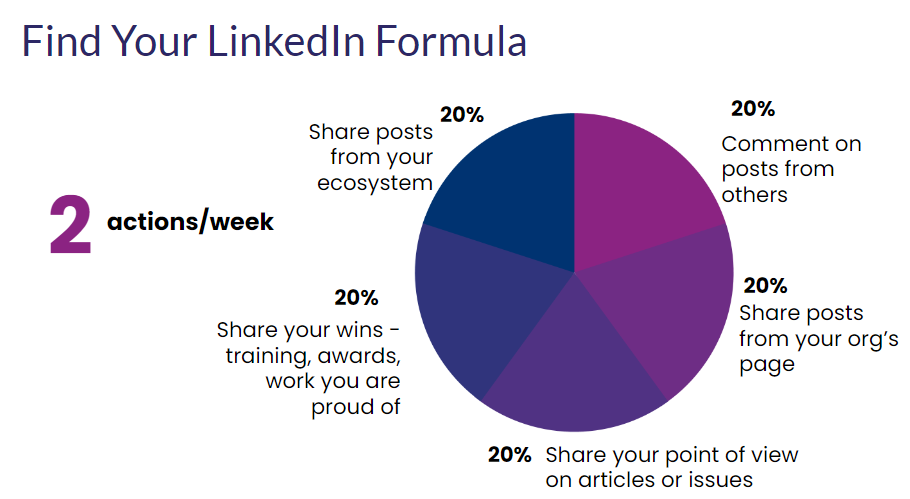
Source: Quickstep LinkedIn Level-Up Workshop
A first step with thought leadership on LinkedIn is building on posts from others. You can share an article and add your comments, add your point of view around a post from your company, or comment on posts from your network. While liking posts is nice, it is much more valuable to add a thoughtful comment — try not to just say, “Congrats!” It will take more time, but offering real insight keeps your comment from being throwaways. Work to open up conversations with your network.
#3 Follow 20 new people on LinkedIn, and include at least 5 from outside your field. When you log into LinkedIn, what you see directly correlates with who you follow. Consider the books you’ve read, the conferences you’ve attended, and the podcasts you’ve heard. Who impressed you? Ask your colleagues for recommendations. Look up executives at organizations you admire. Consider also a few people in creative or spiritual fields that will offer inspiration. Also follow this tip from Natalie Eckdahl of the Impact Collective. Clean house and stop following/disconnect from anyone in your LinkedIn network who isn’t serving you.
#4 Share your point of view and develop your voice. This is the hardest for many people. Some believe they have nothing original to say. Others have a clear point of view and issues they want to talk about, but can’t carve out the time. It’ best to just start. Write a post of something that’s been on your mind. Pose a question to your network. Share a photo with a story others can learn from. You will start to get feedback and see what resonates, then you can build from there. Just be sure you’re not only broadcasting your own content. Take time to listen and raise other voices.
#5 Use LinkedIn Analytics to track progress. In just five minutes you can click on “Analytics” to see which of your posts have had the most engagement and impressions this week/month/year. Clicking on the number of followers at the top of your profile will show you who has followed you recently. Finally, click on “Show all activity,” then “Posts” to see and respond to comments on your posts. Use this feedback to determine which posts work best and monitor how your efforts are growing your following.
Although LinkedIn has the potential to generate impressions and traffic, the social network's value extends far beyond your number of followers and likes. LinkedIn can build synergy and connections that lead to new relationships and opportunities. Perhaps most important, it's a place where you can share your ideas and show how and what you think. People will have a more meaningful understanding of you before they engage with you, which helps speed things along when you do connect.
Gwen Gulick is founder and principal of Quickstep